
Opposition Alliance Unveils ₹600 National Minimum Wage
The 32-party coalition promises a mandatory national floor of ₹600 per day, directly challenging the ruling government's economic record.
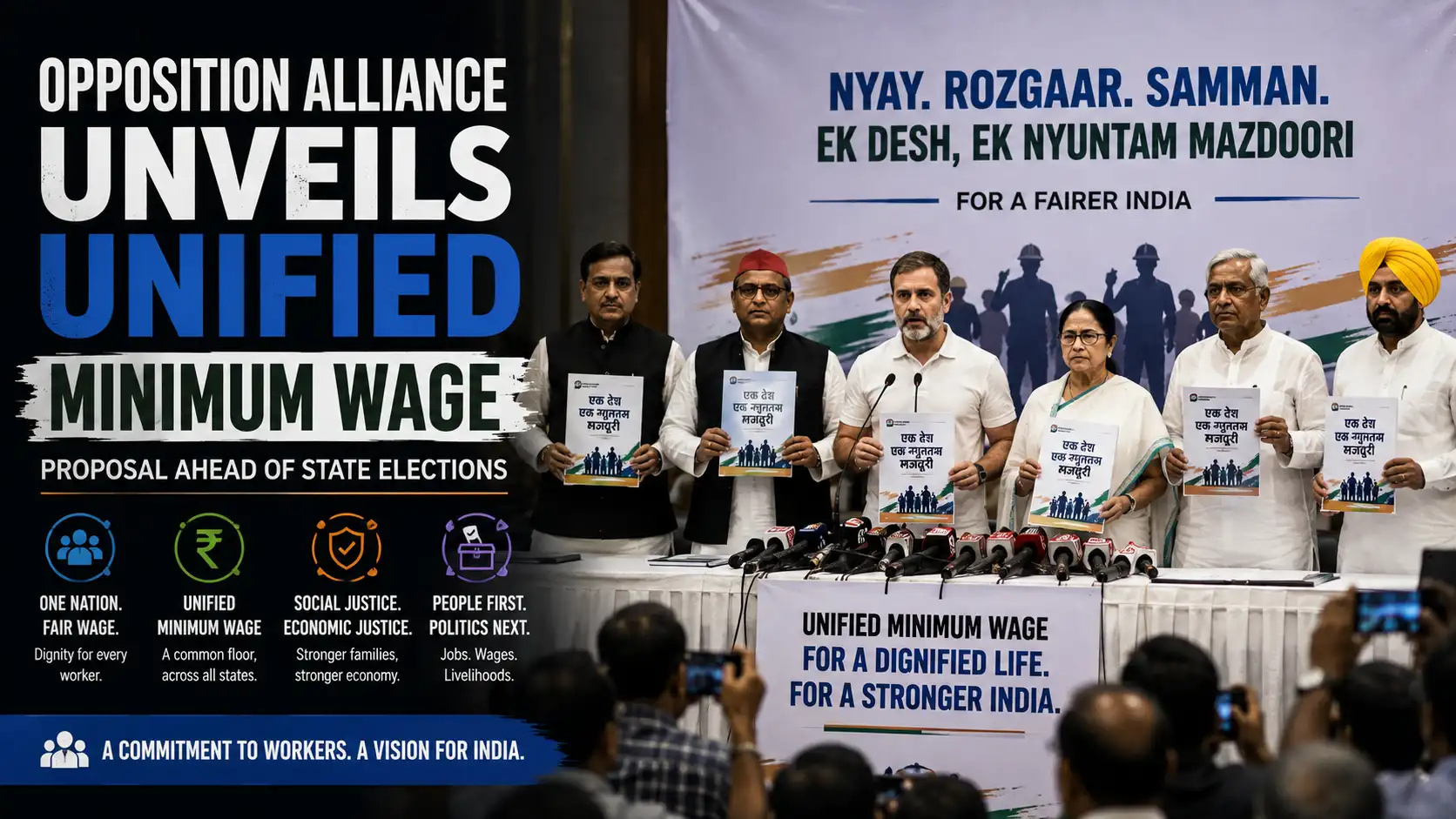
In a sharply coordinated political maneuver ahead of crucial assembly elections in four states, the unified opposition alliance unveiled a comprehensive national minimum wage proposal. The policy framework, formally introduced at a massive rally in Bhopal yesterday, promises a mandatory, non-negotiable floor wage of ₹600 per day for all unskilled workers across both organized and unorganized sectors.
A Direct Challenge to the Economic Narrative
Observers at the announcement noted the electric atmosphere. This policy is not merely another campaign promise. It serves as a direct, calculated strike at the ruling coalition's economic narrative, which has heavily favored supply-side reforms and corporate deregulation over the past decade.
The mechanics of the proposal are ambitious. Currently, India’s minimum wage structure is a labyrinth of state-specific schedules, varying wildly from ₹180 in some agrarian districts to over ₹550 in urban hubs like Delhi. The opposition's draft legislation proposes collapsing this complex tier system into a single, federally mandated baseline, indexed to inflation using the Consumer Price Index for Industrial Workers (CPI-IW).
We are ending the era of wage arbitrage where states compete to offer the cheapest labor to capital," declared the alliance chairperson during her 40-minute address. "A family cannot survive, let alone educate their children or access healthcare, on ₹250 a day. Our proposal guarantees dignity, not just survival.
The immediate political fallout was predictably polarized. The ruling party dispatched its finance minister to counter the narrative within hours. In a hastily convened press conference at the North Block, the minister dismissed the proposal as "fiscal adventurism" that would inevitably trigger hyperinflation and cripple small and medium enterprises (SMEs).
If you force a uniform ₹600 wage across the board, the local textile units in Tirupur or the brassware workshops in Moradabad will simply shut down," the finance minister argued. "They operate on razor-thin margins. You aren't creating wealth; you are mandating unemployment.
However, labor economists remain divided. Dr. Raghuram Desai, a senior fellow at the Center for Economic Policy, suggests the reality is more nuanced. "A sudden 50% jump in rural wages would undoubtedly stress micro-enterprises," Desai noted in a recent policy brief. "But the resulting consumption boom at the bottom of the pyramid could offset those costs within three quarters. When poor people get more money, they spend it immediately on food, clothing, and basic durables. That drives demand."
The timing of the announcement reveals a clear strategic choice. The opposition has chosen to frame this election entirely around livelihood issues, side-stepping the cultural and nationalist flashpoints that the ruling party traditionally dominates. They have recognized a palpable fatigue among the electorate regarding jobless growth. While GDP figures remain robust at 6.8%, real wage growth for rural labor has stagnated for five consecutive years.
Funding the Wage Guarantee
To fund the increased wage burden for government-contracted schemes like MGNREGA (which currently employs millions at lower state-specific rates), the opposition proposes a 2% wealth tax on the top 1% of earners. This Robin Hood approach plays exceptionally well on the campaign trail, even if the bureaucratic machinery required to enforce such a tax remains entirely theoretical.
The business community's reaction has been swift and severe. The Confederation of Indian Industry (CII) issued a terse statement warning that statutory wage floors divorced from productivity metrics would accelerate automation and push more jobs into the informal shadow economy. They argue that employers will simply stop hiring on the books, relying instead on off-the-books daily wagers to bypass the ₹600 mandate.
Yet, reports from rural constituencies in Madhya Pradesh this week suggest the resonance of the ₹600 promise is undeniable. At a tea stall outside Vidisha, local construction laborers earning ₹300 for a ten-hour shift dismissed concerns about potential job losses. As one laborer noted, the cost of basic provisions like dal and cooking oil has doubled in three years while wages have stagnated, leaving many struggling to survive despite working full days.
This sentiment is exactly what the opposition alliance is betting on. They have successfully shifted the political conversation from abstract macro-economic achievements to the dinner-table realities of the working class.
The ruling coalition now faces a difficult strategic choice. They must decide whether to continue defending their record of fiscal prudence and infrastructure development, which resonates with the urban middle class and international investors, or announce a counter-welfare package to blunt the opposition's momentum.
Similar dynamics have played out before. In 2019, faced with agrarian distress, the government launched the PM-KISAN cash transfer scheme just months before the general election. Whispers in the capital suggest the Finance Ministry is currently running stress tests on a limited urban employment guarantee scheme, essentially a city-based version of MGNREGA.
Whatever the counter-move, the opposition has achieved its primary objective: controlling the narrative. By planting the ₹600 flag, they force every political debate in the coming months to revolve around the labor share of income. It is a bold, high-risk strategy. If the electorate buys the government's argument that this will cause mass layoffs, the alliance will face a humiliating defeat. But if the anger over wage stagnation overrides economic caution, the country might witness a fundamental realignment of Indian politics.
Abhijit Chowdhury
Staff Reporter
Editorial administrator for Eastern Times.
You May Also Like
Parliament Monsoon Session 2026: Deadlock, NCPI Row and What Survives After Pradhan
Delimitation Commission to Redraw 543 Seats Using 2021 Census
Jantar Mantar Crackdown Sparks Civil Liberties Row
Mamata Backs CJP in NEET Protests
Parliament Erupts Over NEET Paper Leak and Police Crackdown
NEET-UG 2026 Paper Leak: How Nationwide Student Protests Erupted and Spread Across India
Rajya Sabha Debates Data Sovereignty Amendments
Submit a Perspective for editorial consideration at contact.easterntimes@gmail.com. All submissions are moderated for professional credentials and civil exchange.