
Bihar NEET Protests Turn Violent
Student marches in Patna and clashes across Katihar, Darbhanga and Begusarai turned violent, with police using batons, tear gas and water cannons and at least 14 personnel injured, as the state Assembly erupted.
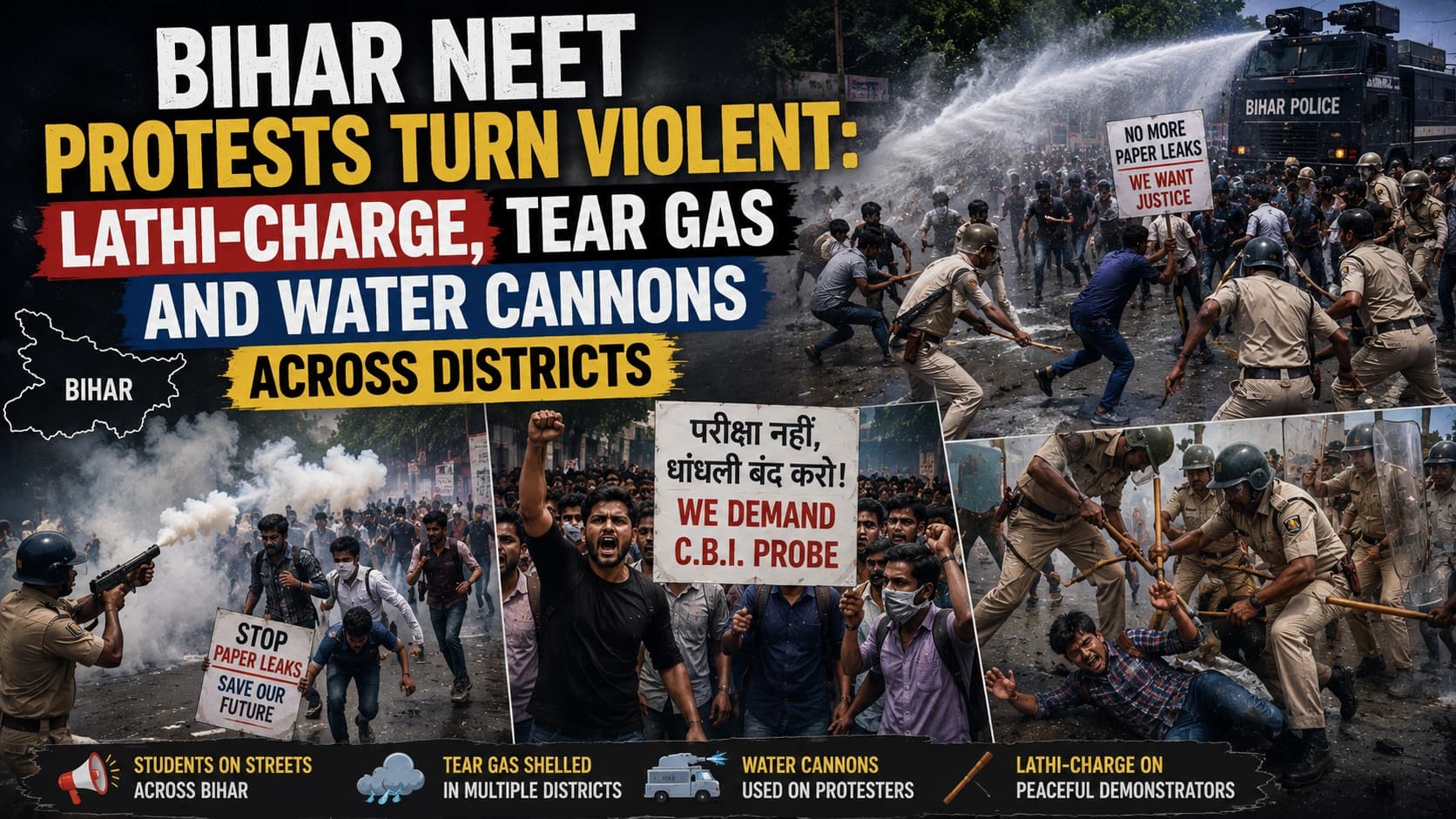
The nationwide agitation over the NEET-UG 2026 paper leak turned its most violent in Bihar this week, where student marches in Patna and a string of district towns spiralled into pitched confrontations with the police. Officers used batons, tear gas shells and water cannons to disperse protesters; students hurled stones; and by the end of Thursday, 23 July, at least 14 police personnel and an unknown number of demonstrators had been injured, according to news agency PTI, reported via ThePrint.
The scale and spread of the unrest — and the ferocity of the clashes — made Bihar the most turbulent theatre of a protest movement that has otherwise been defined by sit-ins and hunger strikes elsewhere in the country.
Pitched Battle At Lok Bhavan
The epicentre was the state capital. On Wednesday, 22 July, hundreds of student activists demanding the resignation of Union Education Minister Dharmendra Pradhan fought what EdexLive (citing PTI) described as a "pitched battle" with police during a march towards Lok Bhavan. To prevent the march from reaching the seat of government, police used tear gas shells, water cannons and batons.
Photographs from the day, carried by The Hindu, showed police using a water cannon on supporters of the All India Students’ Association (AISA) during a "Lok Bhavan March" over alleged examination irregularities and paper leaks in Patna. AISA and other participating student groups said the protest was aimed at highlighting alleged paper leaks and irregularities in the examination system, raising concerns over the privatisation of education and pressing the demand for Pradhan’s resignation, UNI reported.
Violence Spreads Across Districts
The unrest did not remain confined to Patna. According to The Hindu, NEET protests continued in several districts of Bihar, with stone pelting reported in Katihar, Darbhanga and Begusarai. Police resorted to baton charges after protesters pelted stones in Katihar and Begusarai; in one instance, a peaceful protest turned violent when some demonstrators tried to break the main gate of the District Magistrate’s office.
The Indian Express reported that thousands of protesters in Katihar, Darbhanga and Begusarai marched against alleged irregularities in competitive examinations, with the demonstrations escalating into stone pelting in Katihar and police using a "mild lathicharge" in Begusarai to push back protesters. UNI reported that the agitation spread further still, with demonstrations held in Patna as well as Katihar, Sheikhpura, Munger, Begusarai, Vaishali, Motihari, Darbhanga and Nalanda.
Injuries, Firing And FIRs
The clashes took a physical toll on both sides. ThePrint, citing PTI, reported that many students and at least 14 police personnel were injured in clashes across several districts on Thursday, prompting security forces to fire in the air and baton-charge to disperse the agitators. In the aftermath of the Patna violence, UNI reported that an FIR was registered against 500 people, and security around the Assembly was tightened.
Uproar In The Assembly
The street violence quickly became a legislative storm. Both Houses of the Bihar legislature witnessed turmoil on Thursday, 23 July, as members of the ruling National Democratic Alliance (NDA) and the Opposition traded charges over the previous day’s violent student protest in the state capital, The Hindu reported.
In the Bihar Legislative Council, Rashtriya Janata Dal (RJD) MLC Abdul Bari Siddiqui compared the current student protest with the 1974 movement, saying a similar atmosphere now prevailed across the country, according to UNI. The invocation of 1974 — the Jayaprakash Narayan-led student movement that began in Bihar and reshaped national politics — was a deliberate and resonant one, casting the current agitation as part of a longer tradition of student-led dissent originating in the state.
The Political Fault Lines
The Bihar unrest exposed sharp political divisions. Opposition parties framed the police response as excessive and the protests as a legitimate expression of student anger over a broken examination system. The ruling alliance emphasised law and order, pointing to injured officers and attempts to breach government buildings. With Bihar politically sensitive and its student movements historically potent, the stakes of the confrontation extended well beyond the immediate issue of the NEET leak.
The involvement of organised student groups such as AISA gave the Bihar protests a more structured and confrontational character than the largely spontaneous, internet-driven demonstrations seen elsewhere. Their demands — spanning paper leaks, examination reform and opposition to the privatisation of education — broadened the agitation from a single scandal into a wider critique of education policy.
The confrontation also carried an economic subtext that resonates powerfully in Bihar. The state sends vast numbers of aspirants to competitive examinations each year — for medical and engineering seats, for railways and for government jobs — in a context of limited local employment. For many families, a fair exam is the single credible route out of precarity, which is why a leak is experienced not as a distant administrative failure but as a direct theft of opportunity. That intensity of feeling helps explain why the protests in Bihar were larger, angrier and more physical than in many other states.
Echoes Of 1974
When RJD MLC Abdul Bari Siddiqui invoked the movement of 1974 in the Bihar Legislative Council, he was reaching for the most potent analogy in the state’s political memory. The Jayaprakash Narayan-led "JP movement" began as a student agitation in Bihar over corruption and unemployment and grew into a nationwide challenge that ultimately reshaped Indian politics. For a generation of Bihar’s leaders across parties, that movement is the template against which all subsequent student unrest is measured.
The comparison carries a warning and a claim. The warning, directed at the government, is that student anger over broken institutions can escalate beyond anyone’s control. The claim, directed at the public, is that the current protests belong to a noble lineage of youth-led dissent rather than to any narrow partisan project. Whether the 2026 agitation lives up to that comparison or fades is, as yet, unknowable — but the invocation itself raised the political stakes considerably.
AISA And The Organised Left
Unlike the largely spontaneous, internet-driven demonstrations elsewhere, the Bihar protests bore the imprint of organised student politics, particularly the All India Students’ Association (AISA). Its involvement gave the agitation a more structured and confrontational edge, and broadened its demands beyond the immediate NEET leak to encompass examination reform and opposition to the privatisation of education. That ideological framing distinguished the Bihar chapter from the CJP’s satirical, non-partisan origins, and helps explain why the confrontations in the state were more physical and sustained.
The presence of established student outfits also meant the protests could draw on existing networks and experience, mobilising quickly across multiple districts — from Patna and Katihar to Sheikhpura, Munger, Vaishali and Nalanda — rather than relying solely on the viral energy that had powered the movement in the capital.
What Comes Next
The immediate concerns are the treatment of the injured, the fate of those named in FIRs, and whether the violence recedes or escalates further. Politically, the Bihar clashes have added a combustible dimension to the national movement, giving the opposition fresh ammunition and testing the state government’s handling of a restive youth.
The comparison to 1974, whether or not it proves apt, signals how seriously Bihar’s political class is taking the moment. Student movements in the state have, in the past, been the opening act of larger political shifts. Whether this one follows that trajectory or dissipates will depend on how the coming days — in the streets, the courts and the legislature — unfold.