
Jantar Mantar Crackdown Sparks Civil Liberties Row
The Delhi Police action against the Students protest at Jantar Mantar has become a flashpoint in its own right, turning a movement about examination integrity into a national argument over how a democracy should police peaceful dissent.
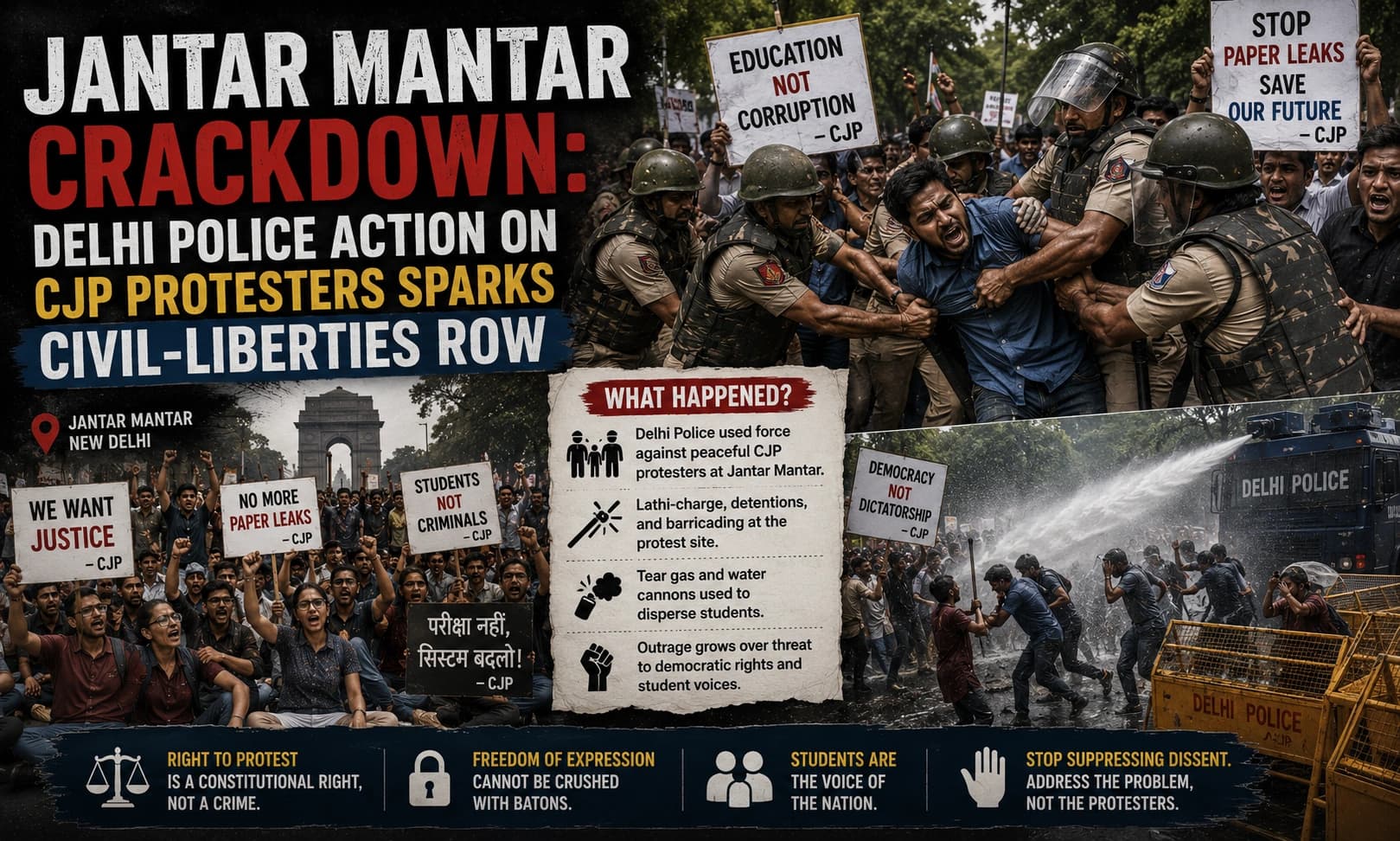
The images that spread across India this week were jarring: plainclothes officers moving into a protest site before dawn, white sheets held up to screen the scene from view, and an activist being carried away on a stretcher. The Delhi Police action against the Cockroach Janta Party (CJP) protest at Jantar Mantar has become a flashpoint in its own right, turning a movement about examination integrity into a national argument over how a democracy should police peaceful dissent.
According to The Hindu, police cracked down on a CJP protest in Delhi on Monday, 20 July 2026, in what it described as one of the largest protests in the national capital in recent years, leaving several people injured. The manner of the operation — and what followed — has drawn sharp criticism from opposition leaders and civil-liberties advocates.
The Pre-Dawn Operation
A ground report by Frontline described the scene in stark terms: at around 6:30 am, plainclothes Delhi Police officials entered the stage area where Sonam Wangchuk was sleeping; volunteers who tried to stop them were pushed off the stage; and officers, holding up white sheets to screen the scene, removed Wangchuk and put him into an ambulance. The account captured the central grievance of the protesters — that a peaceful demonstration was cleared by force in the early hours, away from public view.
Protesters, led by CJP founder Abhijeet Dipke, later reclaimed the dismantled protest site, The Hindu reported, vowing to continue their agitation as they awaited the government’s response to their demands.
Internet Suspended, Hundreds Detained
The security response extended well beyond the clearing of the site. According to LiveMint, internet services were suspended near Sansad Marg, and fresh violence left five police personnel injured. Separately, Times of India’s live coverage reported that more than 200 people were taken into preventive custody, with police describing some of them as "bad characters" — a characterisation that protesters and their supporters rejected.
The suspension of mobile internet in the heart of the capital, close to Parliament, was among the most contentious measures. Internet shutdowns have become a recurring instrument of crowd control in India, but their use in central Delhi during a student protest drew particular scrutiny, given the chilling effect on communication and the documented economic and civil costs of such blackouts.
Conflicting Accounts
The police and the protesters offered sharply different narratives. On one account, reported by The Hindu, initial protests were peaceful and turned confrontational only at specific flashpoints; on another, police maintained they were responding to violence and acting to preserve order. Notably, even as allegations of a crackdown mounted, the Delhi Police at one stage said there was "no plan of a crackdown" on the ongoing protest, dismissing claims by former Delhi Chief Minister Arvind Kejriwal that security personnel could take such steps, according to The Indian Express.
The Political Reaction
The police action became a rallying point for the opposition. Former Delhi Chief Minister Arvind Kejriwal warned that security personnel could move against the protesters, framing the government as intolerant of peaceful dissent. In West Bengal, Trinamool Congress leaders including Mamata Banerjee condemned what they called police "atrocities," with TMC MP Sagarika Ghose describing the use of tear gas against student protesters as "shameful," according to The News Mill.
The issue also rocked Parliament. The Hindu reported that the NEET paper leak and the police crackdown on protesters at Jantar Mantar and neighbouring areas dominated both Houses on Wednesday, 22 July, with the government offering an elaborate discussion even as it accused the opposition of preventing debate through disruption.
The Civil-Liberties Question
Beyond the day’s politics lies a durable constitutional question: how should the state respond when a peaceful protest grows large and persistent? The right to assemble and protest peacefully is fundamental, but it is not unqualified, and authorities routinely cite public order and security to impose restrictions. The Jantar Mantar episode has sharpened the debate over where the line should fall — particularly when the tools deployed include pre-dawn clearances, internet suspensions and mass preventive detentions.
Critics argue that treating student demonstrators as a law-and-order threat risks criminalising legitimate dissent and deepening the very alienation that fuelled the movement. Defenders of the police response counter that large gatherings in a high-security zone near Parliament require careful management, and that action followed specific incidents of violence in which officers were injured.
Why It Matters
The crackdown transformed the story. What had been a protest about examination integrity became, additionally, a protest about the right to protest — a broader and more combustible theme. By clearing the site and detaining hundreds, the authorities may have restored order at Jantar Mantar, but they also handed the movement a fresh grievance and the opposition a potent line of attack.
It also nationalised the confrontation. Images of a pre-dawn clearance and reports of internet suspension travelled instantly across the country, feeding the very demonstrations they were meant to contain and drawing condemnation from opposition-ruled states. In an age of ubiquitous smartphones, an operation conducted behind white sheets could not, in the end, be conducted out of public view. The attempt at discretion became, paradoxically, one of the most widely shared images of the entire agitation.
The Internet Shutdown Debate
Of all the measures deployed at Jantar Mantar, the suspension of mobile internet near Sansad Marg drew some of the sharpest criticism. India has become one of the world’s most frequent users of internet shutdowns as a tool of crowd control, and their imposition in the heart of the national capital — within sight of Parliament — during a student protest struck civil-liberties advocates as disproportionate. Shutdowns disrupt not only protesters’ coordination but also ordinary commerce, journalism and emergency communication, and their legality has repeatedly been questioned in the courts.
Critics argued that suspending connectivity to manage a peaceful demonstration inverted the presumption of a democracy: rather than facilitating the exercise of a fundamental right, the state was curtailing the very means by which citizens document and communicate their dissent. Supporters of the measure countered that it was a temporary, targeted step to prevent the mobilisation of larger crowds in a sensitive zone after violence had already injured officers.
Mass Detentions And Their Aftermath
The preventive detention of more than 200 people, some labelled "bad characters" by police, raised its own set of concerns. Preventive detention — holding individuals not for what they have done but for what they might do — is a blunt instrument, and its use against student protesters invited accusations that legitimate demonstrators were being treated as criminals. The characterisation of detainees as "bad characters" was rejected by the movement and its supporters, who saw in it an attempt to delegitimise the protest by stigmatising those who took part.
How quickly those detained were released, and whether any faced lasting charges, became a measure of whether the state’s response was a proportionate, temporary restoration of order or a broader chilling of dissent. The answer would shape the movement’s grievance narrative in the days that followed.
What Comes Next
The immediate questions concern accountability for the police action, the restoration of normal communications in the affected area, and the fate of those detained. The larger question is whether the government’s subsequent outreach — ministerial visits to Sonam Wangchuk, fast-track courts and a promised new law — can repair the damage done to its standing among the young. For a movement born online and hardened on the street, the memory of a pre-dawn clearance may prove difficult to erase.