
NEET-UG 2026 Paper Leak: How Nationwide Student Protests Erupted and Spread Across India
What began as an online satire embracing the humble cockroach has become the largest youth movement of Narendra Modi’s tenure, with demonstrations from Delhi to Kolkata demanding the resignation of Education Minister Dharmendra Pradhan.
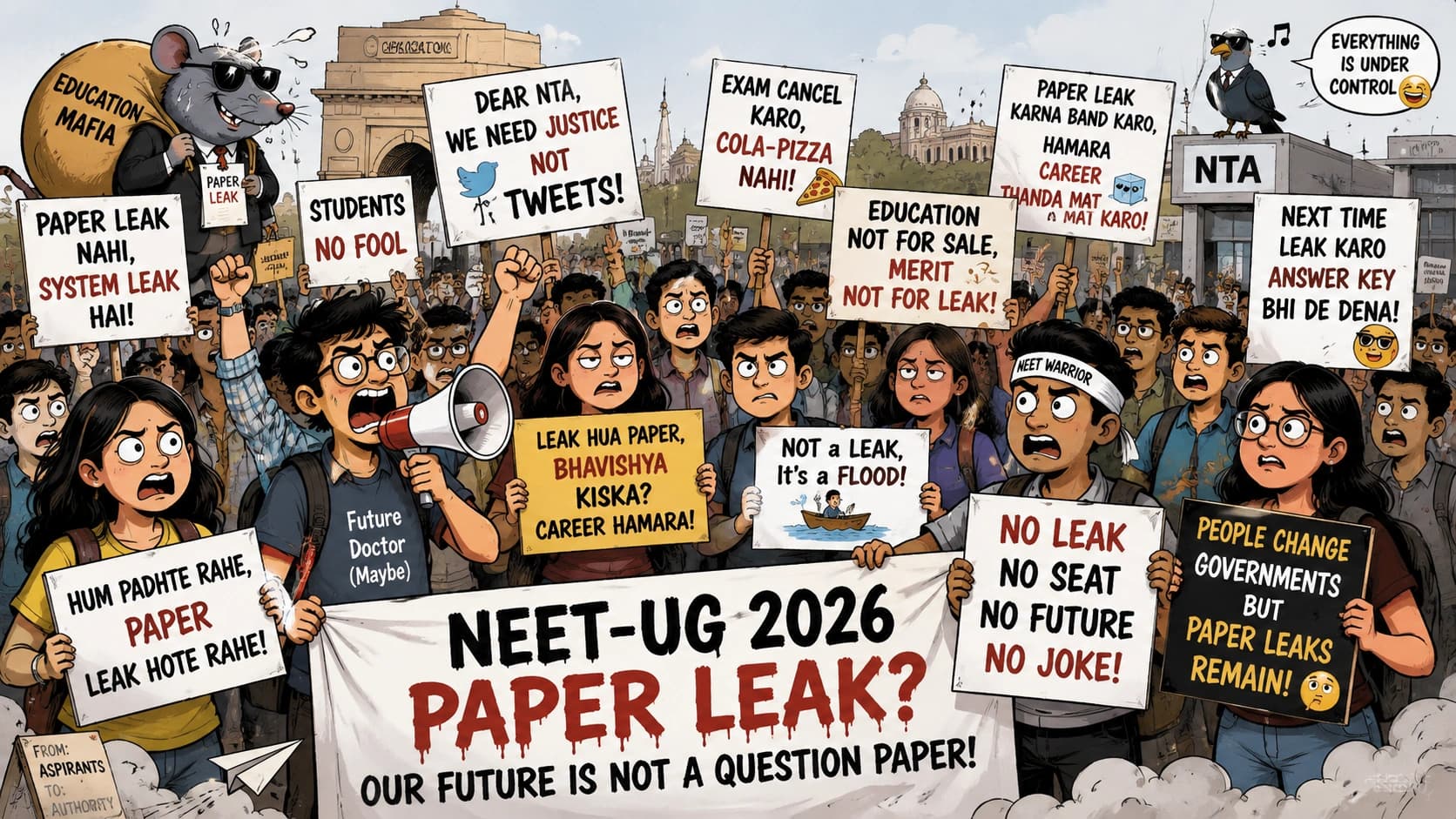
An examination that was meant to decide who becomes a doctor has instead triggered the largest youth protest movement India has seen in years. Over the past week, a demonstration that started at a single protest site in the national capital has snowballed into a nationwide agitation, with rallies reported in Delhi, Mumbai, Bengaluru, Kolkata, Hyderabad and dozens of district towns. The demand uniting them is blunt and singular: the resignation of Union Education Minister Dharmendra Pradhan over the alleged leak of the National Eligibility cum Entrance Test (NEET-UG) 2026 question paper.
According to reporting by India Today, what began as a small sit-in at Delhi’s Jantar Mantar has "snowballed into a nationwide movement," with protesters across multiple states pressing the same resignation demand. The scale, the youth of the crowds and the speed of the spread have combined to hand the government its most sustained street challenge in years.
How It Started
The movement’s roots lie less in a party office than in a social-media feed. The Cockroach Janta Party (CJP) was founded on 16 May 2026 by Abhijeet Dipke, a political communications strategist and former volunteer with the Aam Aadmi Party, as a piece of political satire. As Frontline and other outlets have recounted, the movement adopted the humble cockroach as its emblem — a wry response to remarks in public life that were seen as dismissive of the country’s jobless young. The insect that survives everything became a symbol of a generation that felt talked down to.
The satire did not stay online. On 6 June 2026, thousands converged at Jantar Mantar for a peaceful protest, carrying the movement from screens to the streets and, from the very first day, calling for Pradhan’s resignation. For a campaign born as a joke, the turnout signalled something serious: a reservoir of anxiety among students who treat competitive examinations as the one meritocratic ladder still available to them.
The Trigger: A Compromised Exam
NEET-UG is the single gateway for undergraduate medical admissions in India, taken by roughly 22 lakh aspirants. When the 2026 paper was compromised, the fallout was severe enough to upend the plans of a generation of students and to revive long-standing questions about the integrity of the country’s testing architecture and the National Testing Agency (NTA) that administers it.
For students and their families, a leak is not a bureaucratic mishap to be quietly patched. It is a betrayal of the implicit promise that effort, not connections or cash, determines who advances. That sense of betrayal is the emotional fuel that has kept the protests going for weeks rather than days.
From A Sit-In To A National Movement
Through July, the agitation gathered figures who lent it weight beyond the student core. The Ladakhi educator and innovator Sonam Wangchuk joined the CJP’s cause and began an indefinite hunger strike in support of its central demand, transforming a satirical students’ campaign into a story of moral protest. As the days passed, the demonstration at Jantar Mantar swelled, drawing heavy security deployment and, eventually, police action.
By 23 July, India Today reported demonstrations across Delhi, Mumbai, Chennai, Bengaluru, Hyderabad and Kolkata, with the resignation demand echoing in each. What had been a Delhi story was now a national one, and it was being amplified by opposition leaders who saw in it an issue that cut across region, caste and class.
Who Is Protesting
The crowds are overwhelmingly young — aspirants, recent graduates and student activists — but they have been joined by established groups such as the All India Students’ Association (AISA) in states like Bihar, and by opposition politicians nationally. The breadth is precisely what makes the movement potent: examination integrity is not a wedge issue that divides voters; it is one that tends to unite them.
The Government’s Response
The government has moved on two tracks: enforcement and reassurance. It has pointed to the Public Examinations (Prevention of Unfair Means) Act, 2024 — the anti-cheating law that provides for stringent punishment for organised leaks and malpractice — and has announced fast-track courts to speed prosecutions. Prime Minister Narendra Modi, in a late-night video message on 23 July, promised "more strict" action and a tough new law, a signal that the Centre recognised the political temperature.
At the same time, the government has pushed back hard against the protests’ framing. In Parliament, it offered a discussion on the issue while accusing the opposition of preventing debate through disruption, according to The Hindu. In West Bengal, Bharatiya Janata Party leaders went further, alleging that the agitation had drifted "beyond student issues" into "politically motivated" and even "anti-national" territory — a charge the opposition rejected.
Why It Matters
The NEET protests are significant for reasons that go well beyond a single examination. First, they represent a rare instance of a leaderless, internet-native movement translating online energy into sustained physical protest — a template that will worry any government. Second, the issue is one of aspiration rather than ideology, which makes it unusually difficult to dismiss or polarise. Third, it has arrived during the Monsoon Session of Parliament, handing the opposition a live, emotive grievance to prosecute on the floor of both Houses.
As The Indian Express noted in its analysis, the episode is a reminder that even a government within striking distance of a commanding parliamentary majority must be prepared to face street protests in a young, diverse and aspirational country. Numbers in the Lok Sabha do not, by themselves, settle questions of trust.
The Symbolism Behind The Name
Few protest movements are named after an insect, and the choice was deliberate. As Frontline recounted, the Cockroach Janta Party emerged as a response to a remark in public life that was read as equating the country’s jobless with roaches. Rather than reject the insult, the movement embraced it: the cockroach, the creature that survives everything, became a badge of a generation that felt dismissed and disposable. It was satire as self-assertion.
The reclaiming resonated. According to The Independent, millions of young Indians began "proudly calling themselves cockroaches," turning a term of derision into a mark of solidarity. That act of collective re-labelling is what gave the movement its distinctive texture — irreverent, meme-driven and difficult for conventional politics to co-opt or caricature. Australia’s ABC went so far as to describe the CJP as the biggest youth protest movement of Narendra Modi’s tenure.
A Leaderless, Digital Movement
What distinguishes the CJP from earlier agitations is its architecture. It began on social media and retained a decentralised, internet-native character even after it spilled onto the streets. There is a founder in Abhijeet Dipke, and a moral figurehead in Sonam Wangchuk, but no conventional party hierarchy directing the crowds. That looseness is both a strength and a vulnerability: it makes the movement hard to decapitate, but also hard to sustain and negotiate with.
It has also placed the National Testing Agency squarely under the microscope. The NTA, responsible for conducting the country’s largest entrance examinations, has faced mounting questions about how a paper as consequential as NEET-UG could be compromised. For many protesters, reforming or rebuilding the agency is as central a demand as any resignation — a recognition that the problem is institutional, not merely individual.
The Road Ahead
The immediate flashpoints are threefold. The first is whether the government’s combination of fast-track courts and a promised new law is read as genuine accountability or as an attempt to change the subject from ministerial responsibility. The second is the trajectory of the protests themselves — whether they can sustain momentum after Sonam Wangchuk ended his hunger strike, or whether the movement fragments. The third is Parliament, where the opposition intends to keep the leak and the police response at the centre of the Monsoon Session.
For the millions who sat, or were meant to sit, NEET-UG 2026, the politics is secondary. What they want is a system in which the exam they trained years for cannot be compromised, and in which someone at the top is answerable when it is. Whether the coming weeks deliver that — or merely more promises — will determine if this summer’s movement fades or hardens into something more lasting.