
Parliament Erupts Over NEET Paper Leak and Police Crackdown
The NEET paper leak and the police action rocked both Houses on July 22, with the government offering a debate and accusing the opposition of stalling, as the INDIA bloc pressed for the Education Minister’s resignation.
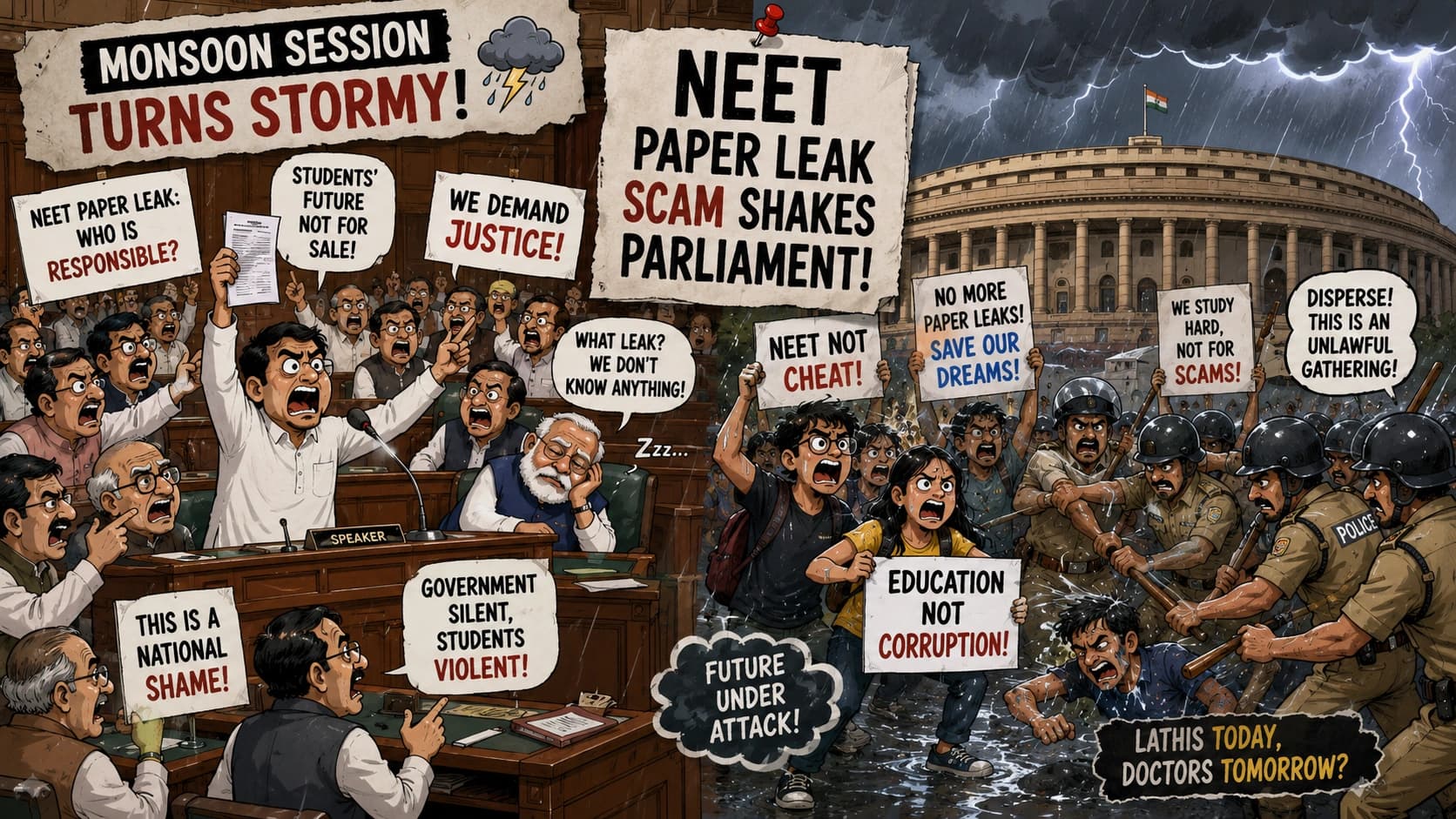
The nationwide agitation over the NEET-UG 2026 paper leak inevitably reached the one arena where it could most directly threaten the government: the floor of Parliament. During the Monsoon Session, the leak and the police crackdown on protesters at Jantar Mantar became the dominant flashpoint, turning what might have been a routine legislative fortnight into a stormy confrontation between the treasury and opposition benches.
According to The Hindu, the issue of the NEET paper leak and the police crackdown on protesters at Jantar Mantar and neighbouring areas rocked both Houses of Parliament on Wednesday, 22 July 2026. The government offered an elaborate discussion on the issue and accused the opposition of not allowing a debate by disrupting proceedings — a familiar choreography in which each side blames the other for the paralysis.
Two Issues, One Storm
What made the parliamentary confrontation potent was the fusion of two grievances. The first was the paper leak itself — the failure of the examination system and the question of ministerial responsibility. The second was the manner in which the state had responded to the resulting protests: the pre-dawn clearing of the Jantar Mantar site, the suspension of internet services near Sansad Marg, and the preventive detention of more than 200 people. Together, they allowed the opposition to prosecute both a policy failure and an alleged assault on civil liberties in the same breath.
The government’s dual response — offering a debate while accusing the opposition of disruption — reflected its strategy of appearing open to discussion while denying that it had anything to answer for on the question of accountability.
The Opposition’s Offensive
For the opposition INDIA bloc, the NEET issue was close to ideal: emotive, cross-regional and rooted in the aspirations of the young. Leader of the Opposition Rahul Gandhi had for weeks kept the issue politically live, holding direct interactions with students and demanding accountability. When Prime Minister Modi released his midnight video promising fast-track courts and a new law, Gandhi dismissed it, accusing the Prime Minister of insulting students’ intelligence, Times of India reported.
The bloc’s central demand remained unchanged: the resignation of Union Education Minister Dharmendra Pradhan and a genuine overhaul of the testing system. From the opposition’s standpoint, the government’s legislative announcements — fast-track courts and a promised Bill — addressed the prosecution of leakers while sidestepping the question of who at the top should be answerable.
Solidarity Across Parties
The opposition’s attack was not confined to the Congress. Leaders across the INDIA bloc lent their voices: NCP’s Supriya Sule called the leak a "systemic failure" and demanded a thorough probe, while TMC MPs condemned the use of tear gas against students as "shameful." The breadth of the criticism gave the parliamentary offensive a coordinated character, with multiple parties converging on the same twin themes of accountability and the right to protest.
The Government’s Defence
The government’s response rested on three pillars. First, it emphasised action: the Public Examinations (Prevention of Unfair Means) Act, 2024, the newly notified fast-track courts, and the promised new Bill. Second, it sought to shift the procedural blame, arguing that it had offered a full discussion and that the opposition was preventing debate through disruption. Third, particularly through its state units, it questioned the motives of the protests, with the BJP alleging that the agitation had been hijacked for a "politically motivated" and "anti-national" agenda.
The Prime Minister’s decision to announce the new legislation for introduction in the second week of the session was itself a parliamentary manoeuvre — an attempt to move the debate from the emotive terrain of resignation to the firmer ground of law-making, where the government’s majority is decisive.
Why The Session Matters
Parliamentary sessions are where street movements are either absorbed into the political system or rebuffed by it. By forcing the NEET issue onto the floor, the opposition ensured that the government could not simply wait out the protests. By offering a debate and fast-tracking legislation, the government sought to demonstrate responsiveness without conceding the resignation that the protesters and the opposition demanded.
The disruptions themselves — adjournments, sloganeering and the trading of blame — are a familiar feature of Indian parliamentary life, but they carry a cost. Each lost sitting is a lost opportunity for the structured scrutiny that a serious governance failure demands, and each side calculates whether the political benefit of confrontation outweighs the reputational cost of paralysis.
The Choreography Of Disruption
The scenes in Parliament — adjournments, sloganeering in the well of the House, and the trading of accusations — followed a script familiar to anyone who has watched Indian legislative sessions. The government offers a debate on its own terms; the opposition insists on a discussion under a rule that entails greater accountability, or demands a resignation the government will not concede; each accuses the other of stalling; and the House loses sitting after sitting to the impasse. On the NEET issue, that pattern played out on 22 July, with the government saying it was willing to discuss the matter and the opposition pressing its own demands.
Beneath the theatre lies a real contest over procedure and framing. Whether a debate happens under a rule that merely permits discussion or one that entails a formal reckoning is not a technicality; it determines how sharply a minister can be held to account. The choice of instrument is therefore itself a subject of the fight, not a neutral backdrop to it.
A Crowded Legislative Agenda
The NEET confrontation did not unfold in isolation. The Monsoon Session had opened with a full legislative programme, and the government’s decision to slot the new anti-paper-leak Bill into the second week meant the exam controversy would now compete with, and partly crowd out, other business. For the government, converting the crisis into a Bill offered a way to reclaim the agenda; for the opposition, every day the leak dominated proceedings was a day the government was kept on the defensive.
The session thus became a microcosm of a broader truth about Indian politics: that a government commanding a majority can pass laws almost at will, but cannot, by numbers alone, dictate the public mood. The street had set the agenda; Parliament would now decide whether the response amounted to accountability or merely to legislation.
What Comes Next
The session’s trajectory now hinges on the promised anti-paper-leak Bill, slated for introduction in the week beginning Monday. Its passage will test whether the government can convert a defensive crisis into a legislative achievement, and whether the opposition can sustain its pressure once the debate shifts to the specifics of a law. The resignation demand, meanwhile, is unlikely to be met — resignation demands rarely are — but it will continue to set the emotional temperature of the House.
For a Monsoon Session that opened with a crowded legislative agenda, the NEET paper leak has become the defining issue, binding together the story of a compromised exam, a nationwide youth movement, a contested police response and a government determined to answer with law rather than with a minister’s head. How that contest resolves will shape not only the fate of a Bill, but the political mood of the months ahead.