
Wall Street Rattled as Oil Nears $100
Tesla crashed roughly 14% and Alphabet fell about 6% on AI-spending worries, while Brent crude's surge past $100 a barrel pushed September rate-hike odds sharply higher ahead of the Fed's July 28-29 meeting.
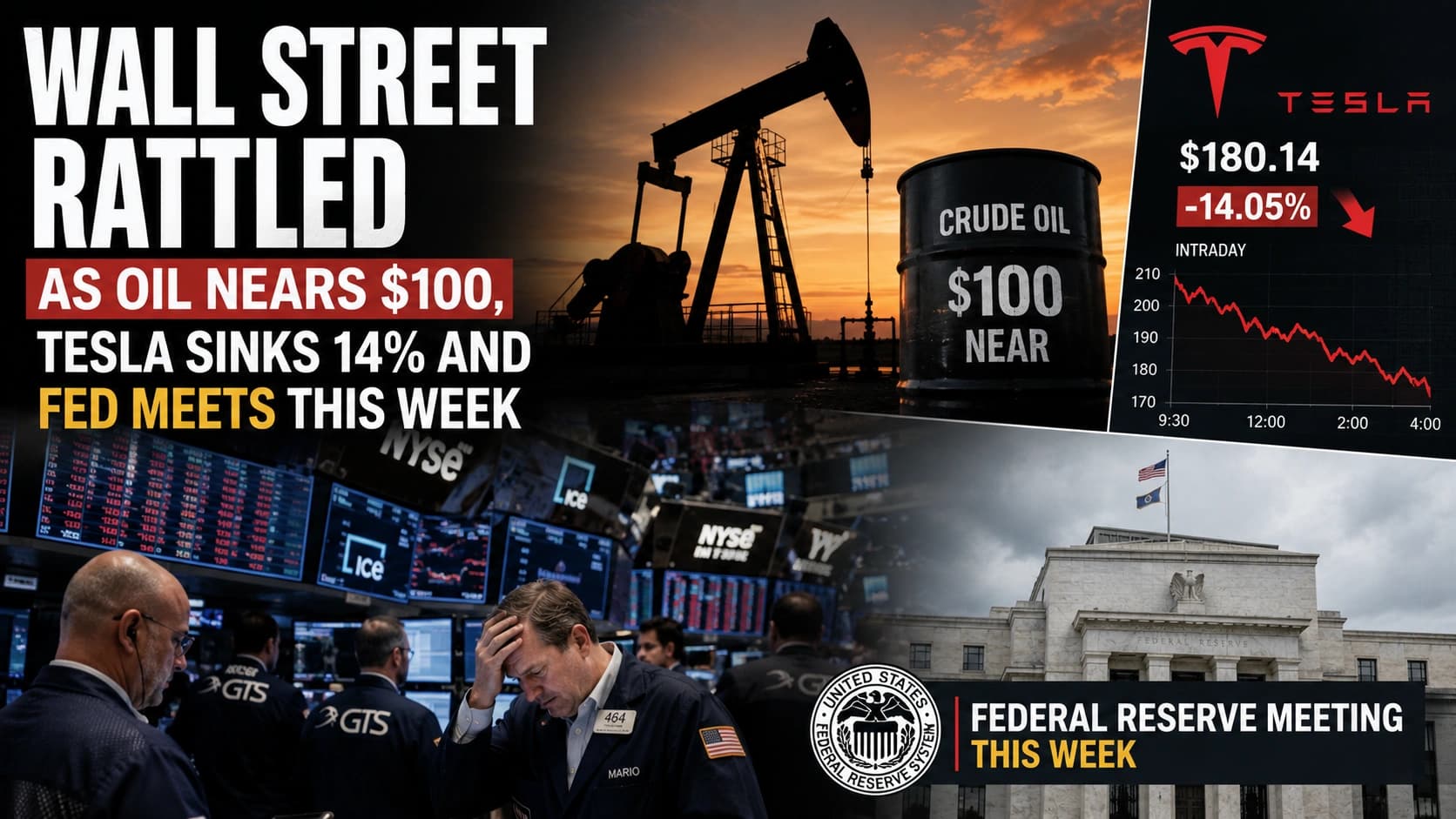
Two storylines collided on Wall Street this past week, and between them they explain almost everything about how US markets have traded through the back half of July. Break up the long sentence into two or three shorter ones for better clarity. The second is macro: Consider rephrasing for better subject-verb agreement and clarity.
Consider removing the duplicate title or rephrasing it for better clarity.
Tesla's second-quarter results captured the market's mood in miniature. Consider rephrasing to make the sentence more active and engaging. But adjusted earnings landed at $0.33 per share, badly missing the roughly $0.53 Wall Street had expected, as Consider rephrasing for better clarity and concision. Operating expenses jumped 47 per cent, driven by AI compute spending, research costs and stock-based compensation tied to chief executive Elon Musk's 2025 performance award. Consider rephrasing for better clarity and concision.
Alphabet told a similar story with different numbers. The Google parent posted revenue of $119.8 billion, up 24 per cent year-on-year and comfortably ahead of the roughly $117 billion analysts had projected — one of the stronger top-line beats among the so-called "Magnificent Seven" mega-caps this earnings season. Yet the stock still fell as much as 6-7 per cent across the following sessions, as investors zeroed in on Alphabet's disclosure of negative free cash flow and a commitment to sharply higher capital expenditure to fund its AI infrastructure build-out.
Two companies beat revenue estimates by a wide margin and both got sold off hard. The market isn't punishing growth — it's punishing the price of buying that growth with borrowed patience on cash flow.
The AI Capex Question Investors Are Actually Asking
What unites the Tesla and Alphabet selloffs is not a shared business problem but a shared investor anxiety: after several years of treating "invest more in AI" as an unambiguously positive signal, markets are beginning to ask harder questions about the return on that spending. Negative free cash flow at two companies this large, reported in the same week, was enough to tip sentiment from patient optimism to visible unease — a reminder that the AI investment boom, whatever its long-run merits, is being funded in the short run by cash that would otherwise flow to shareholders or the balance sheet.
The broader market absorbed the shock unevenly. The S&P 500 fell roughly 1.2 per cent and the Nasdaq Composite dropped more than 2 per cent on the day the selloff peaked, weighed down heavily by the two stocks' combined market-cap loss. Memory-chip makers Micron and SanDisk sold off separately later in the week on unrelated demand concerns, and Netflix shares slipped after its own earnings report, adding to a sense that the "beat and drop" pattern was becoming the week's dominant market narrative rather than an isolated event.
Oil, Inflation And The Fed's Dilemma
Layered on top of the earnings turbulence is a macro story that has moved just as fast. Brent crude crossed back above $100 a barrel for the first time since May, driven by the reimposition of the US naval blockade against Iran and a fresh round of American airstrikes on Iranian targets — developments detailed in our coverage of the wider Gulf conflict. The move pushed the 10-year Treasury yield briefly to its highest level of 2026, above 4.7 per cent, its highest reading since January 2025.
The reaction in rate-hike expectations has been unusually sharp for a single week. Futures-implied odds of a Fed rate hike at the September meeting, tracked through the CME's FedWatch tool, jumped from roughly 12 per cent to as high as 82 per cent by some measures, as traders concluded that sustained $100 oil could force the Fed's hand on inflation even as growth signals remain mixed. Separately, weekly jobless claims fell to their lowest level since 1969, a data point that on its own would argue for a resilient labour market able to absorb higher rates without cracking — but which, combined with the oil shock, has mostly served to widen the range of plausible outcomes rather than narrow it.
Market Snapshot: The Week's Key Numbers
| Metric | Figure |
|---|---|
| Tesla share price move (multi-session) | ~-12% to -14% |
| Alphabet share price move (multi-session) | ~-6% to -7% |
| Tesla Q2 revenue | $28.24 billion (+7.1% beat) |
| Tesla Q2 adjusted EPS | $0.33 (vs ~$0.53 expected) |
| Alphabet Q2 revenue | $119.8 billion (+24% YoY) |
| Brent crude | ~$100/barrel (first time since May) |
| 10-year Treasury yield | ~4.7% (highest since Jan 2025) |
| Fed September hike odds (futures-implied) | ~12% → ~82% within one week |
What The Fed Is Expected To Do
The Federal Open Market Committee meets July 28-29, with its rate decision due Wednesday, July 29, and the consensus expectation is that it holds its benchmark rate steady in the 3.50-3.75 per cent range for a fifth consecutive meeting. Fed chair Kevin Warsh has reiterated a commitment to the central bank's 2 per cent inflation target, language markets are parsing carefully for any hint that the oil shock has shifted the Committee's internal debate. A hold, if delivered alongside notably more hawkish commentary about inflation risk, would in practice validate much of what futures markets are already pricing for September — even without an immediate move this week.
The Fed is not operating alone. The Bank of England and the Bank of Japan both have policy decisions in the same window, and each faces a version of the same trade-off between energy-driven inflation and fragile growth. A coordinated hawkish tilt across the three institutions would mark a meaningful turn in the global monetary cycle; a more cautious, wait-and-see posture from any of them would suggest central bankers are still betting the oil spike proves temporary.
What It Means For Markets Going Forward
Taken together, the week's events point to a market wrestling with two separate but reinforcing sources of uncertainty: whether the AI investment cycle's enormous capital demands can be sustained without further punishing the stocks funding it, and whether a geopolitically driven oil shock will force central banks into a tightening cycle that equity markets have not priced for. Neither question resolves cleanly this week, but the Fed's decision on Wednesday, and whatever language accompanies it, will be the next major data point investors use to answer both.